Neural and behavioral data aren’t always clean, and they never are. I enjoy exploring different ways of analysis that can turn noisy data into informative scientific results.
Continuous-time deconvolutional regression
CDR
How do linguistic features influence responses over time when successive words arrive at irregular intervals?
CDR estimates the delayed and overlapping effects (an impulse response function) of timestamped stimuli-driven predictors. It is useful for naturalistic language because a word’s influence can persist beyond its offset.
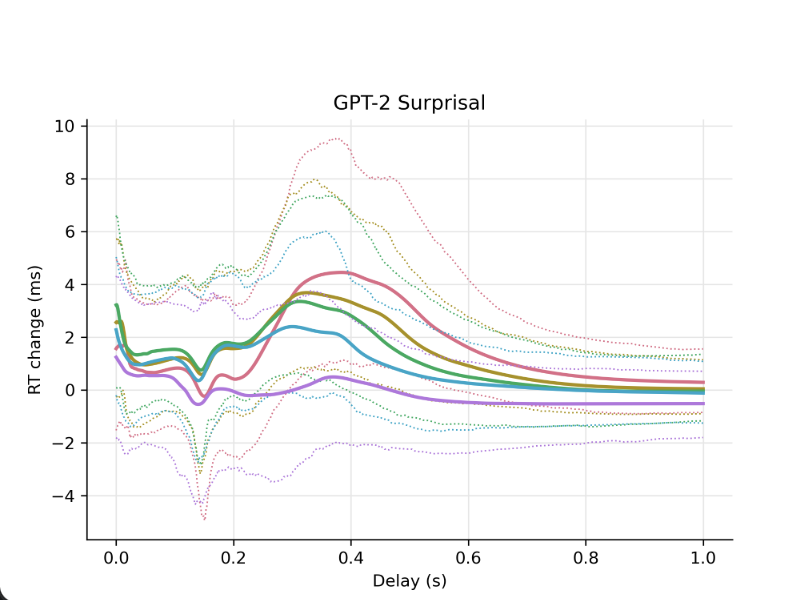
CDRNN estimates of the effect of GPT-2 surprisal on self-paced reading time across repetition conditions, plotted as reading-time change in milliseconds against delay from word onset.
A CDR-GAM approach extends CDR by using smooth curves to estimate how predictors relate to neural responses, sharing CDR’s goal of estimating predictor effects in continuous-time events.
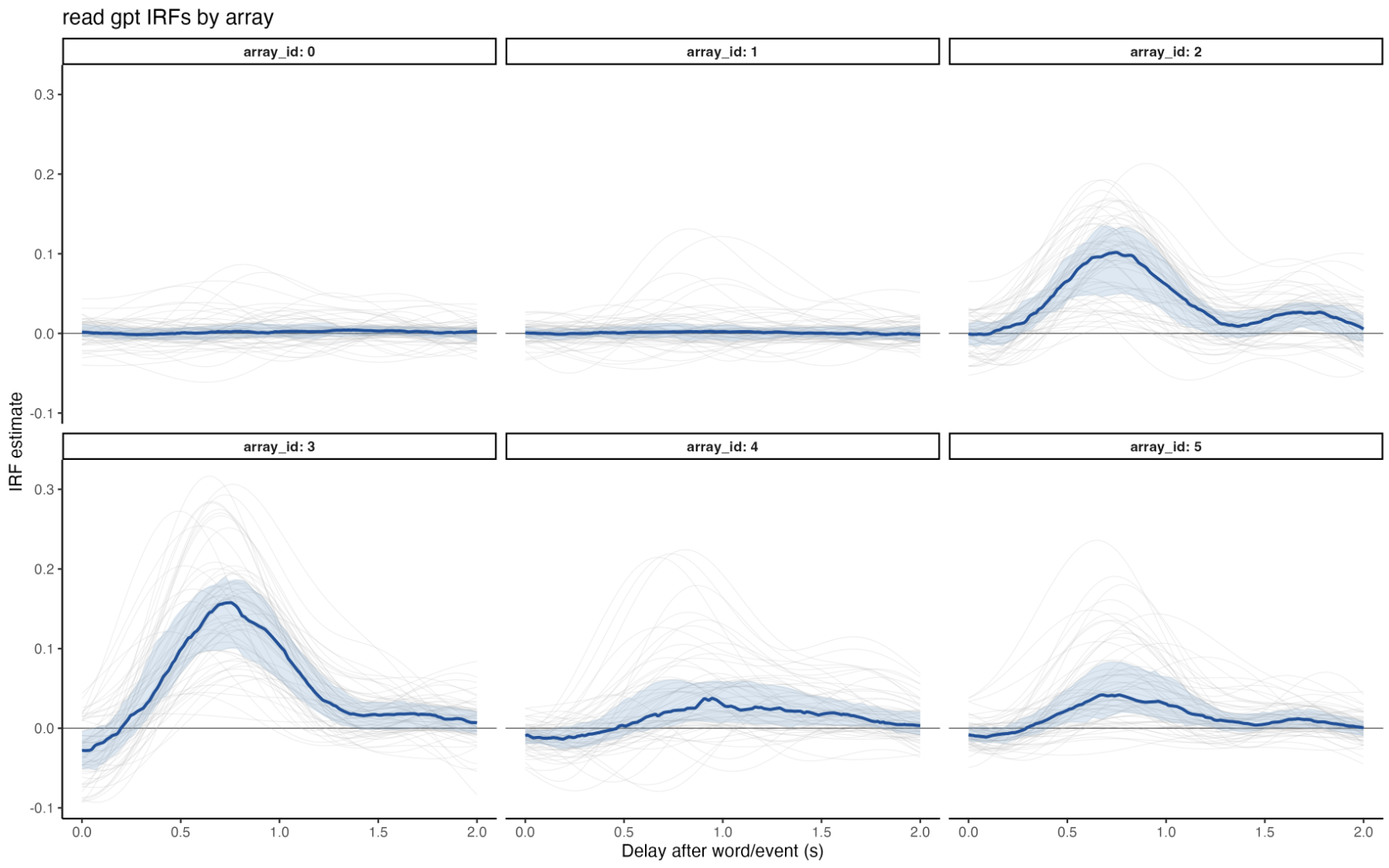
CDR-GAM-derived impulse-response estimates for a GPT-based predictor relavent to word onset during naturalistic reading, shown separately for six intracortical arrays.
Principal component analysis
PCA
How are the linguistic features represented in the populations of neurons in lower dimensional space?
PCA reduces activity across many neurons to a few components that capture the largest sources of variation, helping visualize how population activity changes over time relavent to differnet word features.
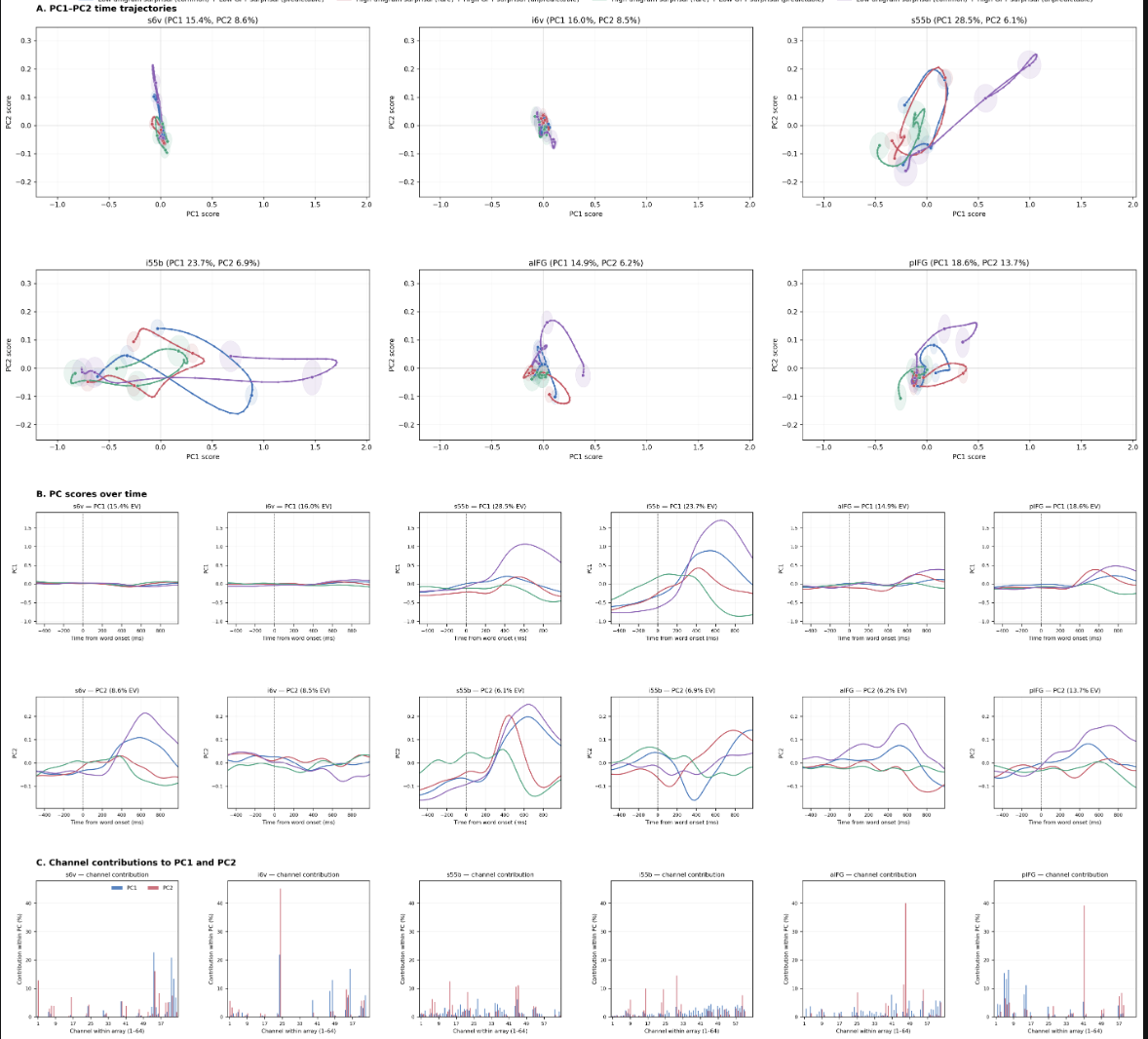
Population dynamics across six intracortical arrays: PC1–PC2 temporal trajectories relevant to the start and end of the word, and channel contributions to each component. Percentages indicate explained variance.
How much stimuli-related features can be predicted from held-out neural data over time at different time windows?
Cross-validated regression model is used to predict held-out neural data from stimuli-related features over different time window across the word, which quantifies how well neural activity encodes specific linguistic features at various points in time.
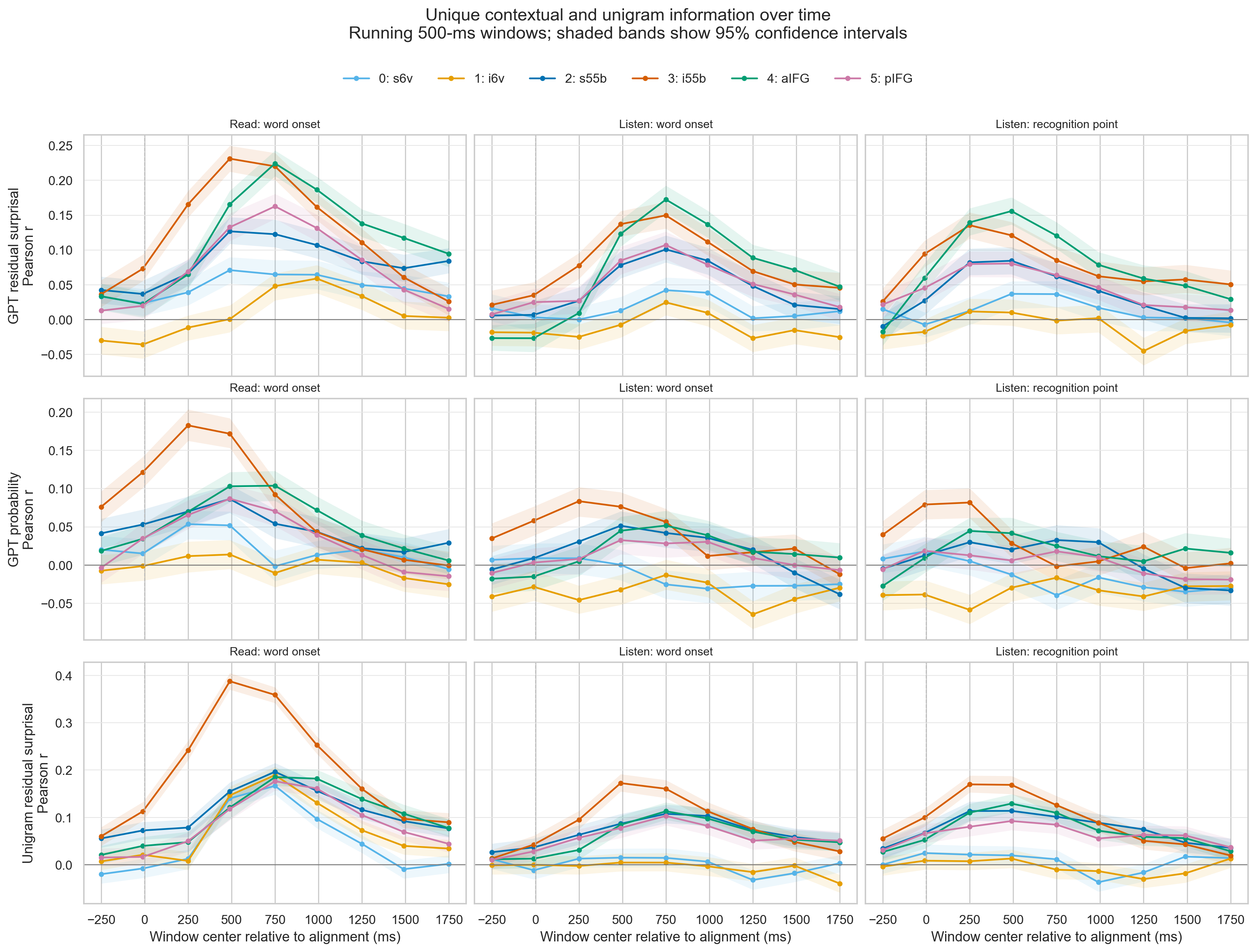
Example shows decoding scores across six intracortical arrays in running 500-ms windows. Rows show GPT residual surprisal, GPT probability, and unigram residual surprisal. Score is measured as the Pearson correlation between predicted and actual neural responses within each window.
Generalized psychophysiological interactions
gPPI
How does coupling with language and speech–motor regions change as a function of different tasks?
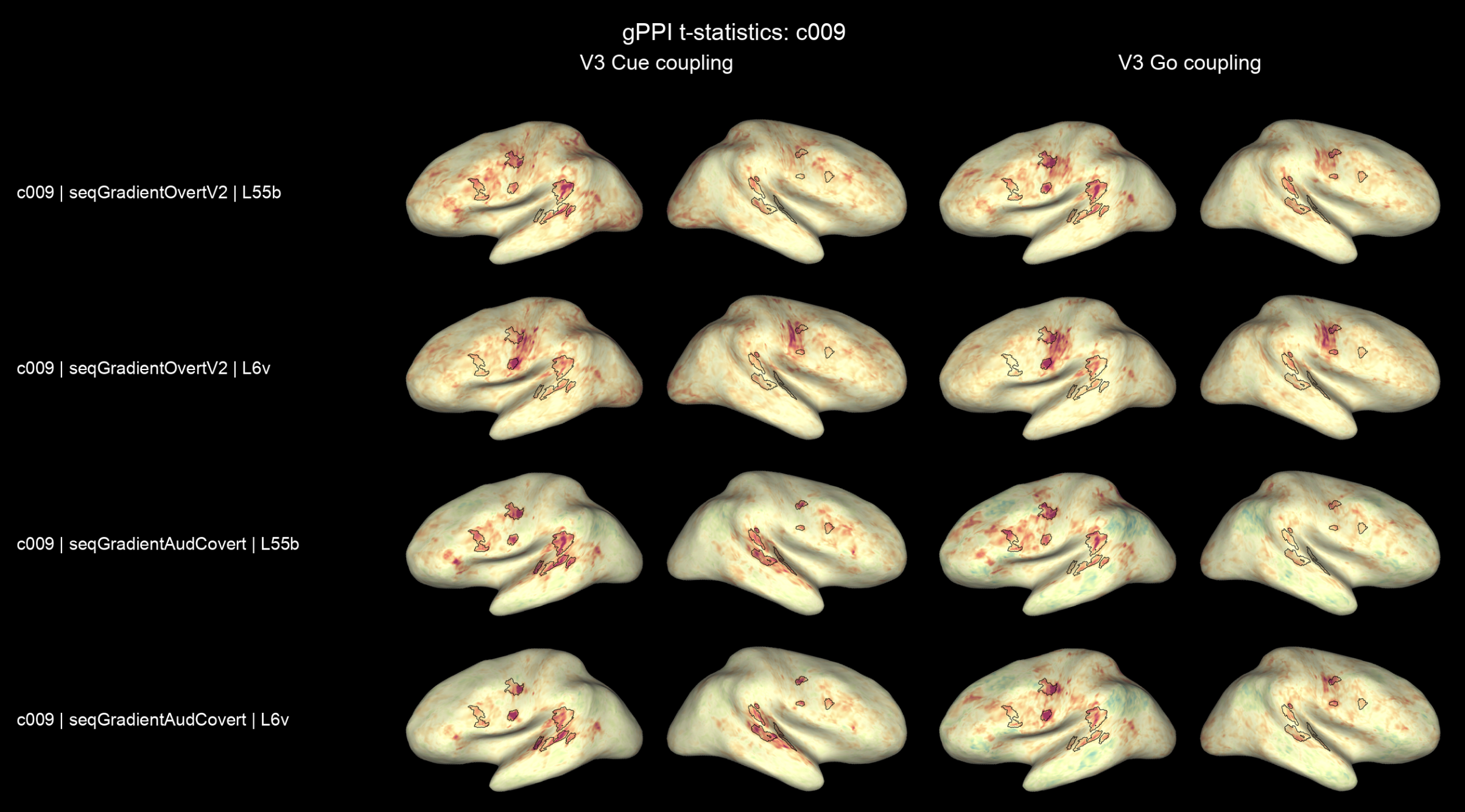
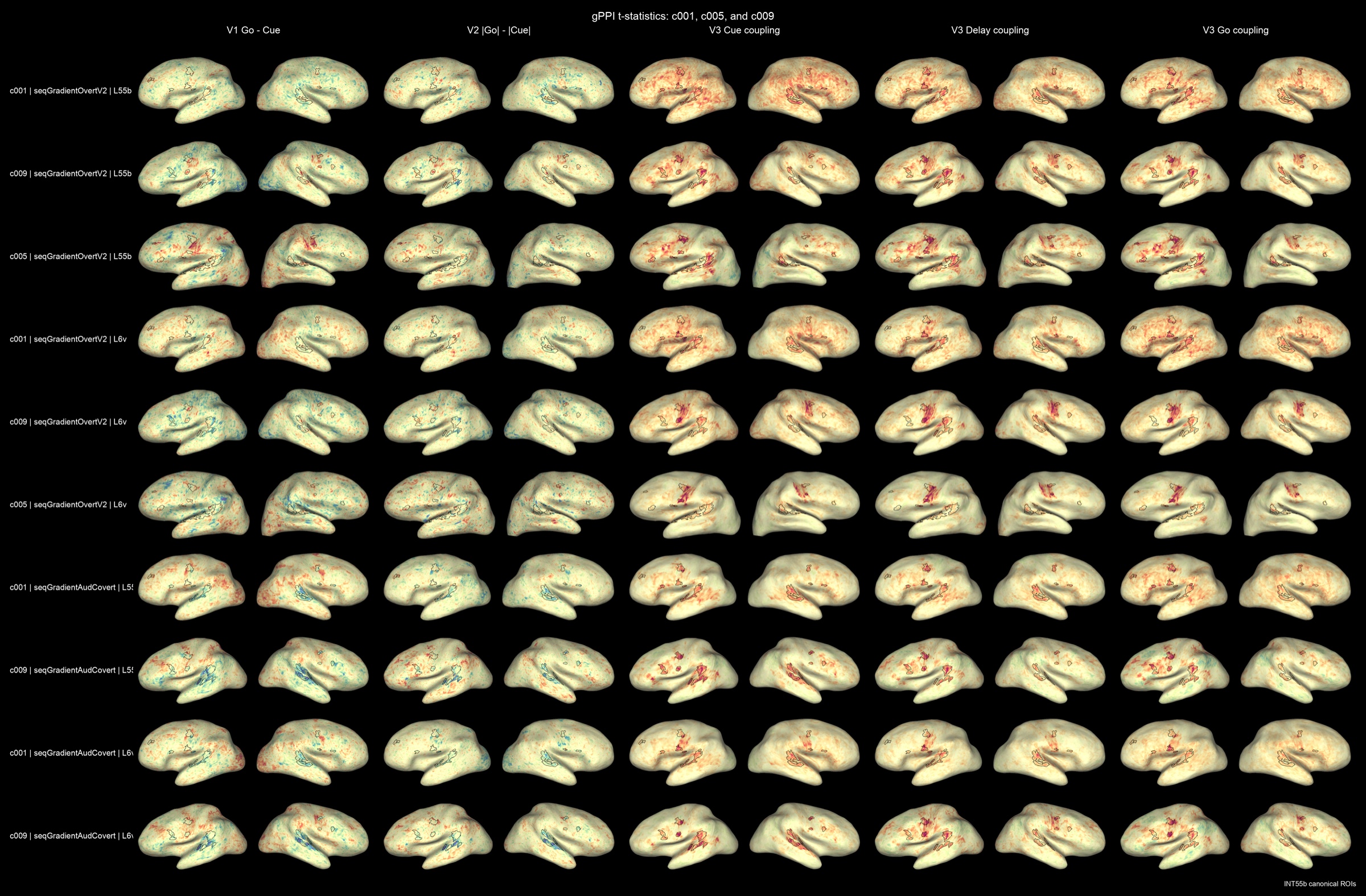
gPPI models how the relationship between a seed region and other regions (target regions) varies with task context, beyond their intrinsic connectivity based on GLM estimation.
Participant-level gPPI t-statistic maps for Cue and Go coupling with left 55b and left 6v seeds, shown for overt and auditory covert sequence tasks..
Do neural population patterns reflect theoretical-driven model predictions?
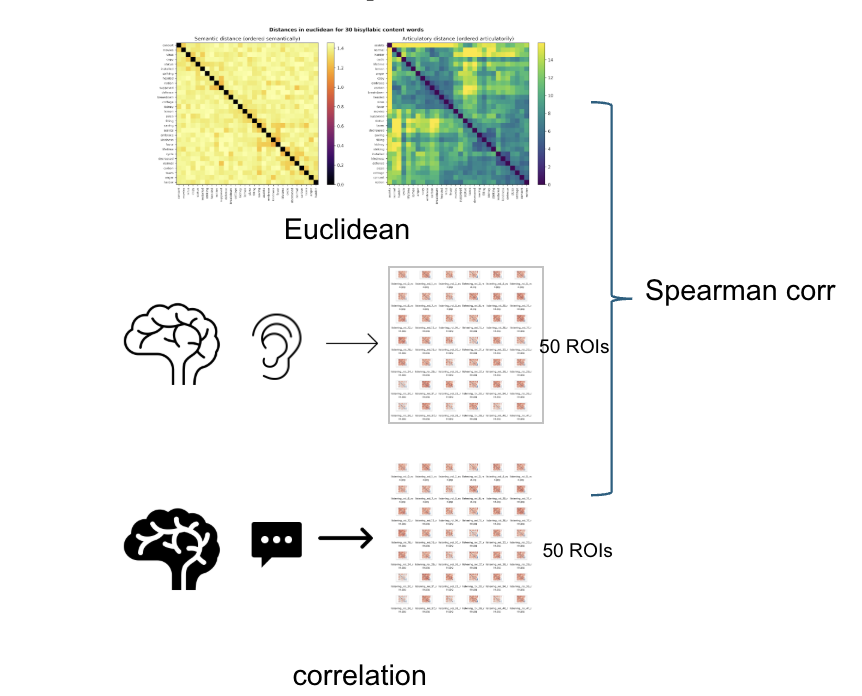
RSA compares the geometry of response patterns with predictions from task variables or computational models. It tests how various experimental conditions are organized relative to how neural population patterns are represented, and infers whether the neural representations align with theoretical expectations.
RSA workflow for comparing semantic and articulatory distance patterns with neural dissimilarity patterns during listening and speaking of words across 50 regions of interest.